
West Virginia Court Records After Arrest
An arrest record and a court record answer different questions. Booking into a regional jail shows the custody event. Court records after a jail arrest show what the prosecuting authority filed, whether charges changed, how bond was handled, and whether the case ended in dismissal, plea, conviction, transfer, or another disposition. WVDCR's own search disclaimers tell users to consult the court with jurisdiction for court-history details.
The West Virginia inmate records page is the better source for custody lookup, while booking-photo questions belong on the jail roster mugshots page. Court records after a jail arrest are a separate path through the West Virginia Judiciary, WVPASS, Magistrate Case Record Search, and local clerks.
The West Virginia Judiciary court-record access page links the statewide court-search routes.
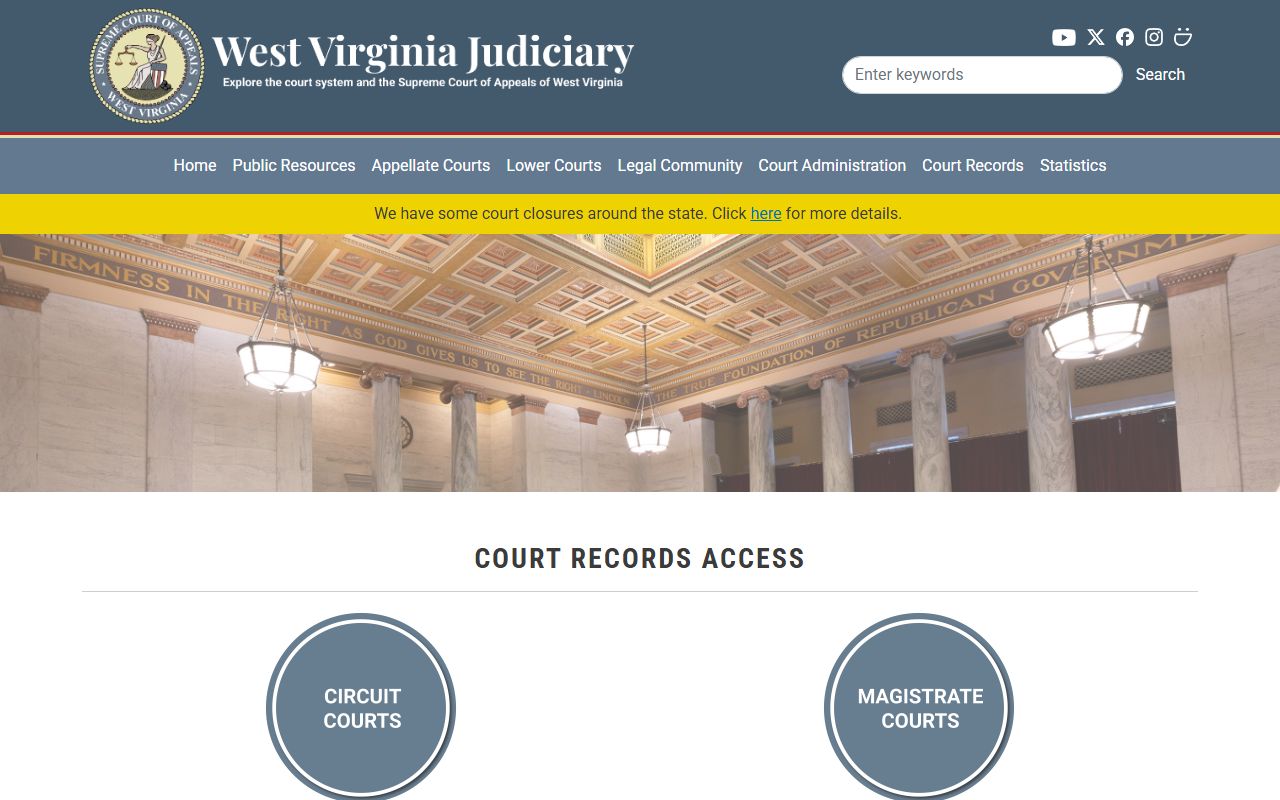
That page is the first statewide court stop because it separates circuit and magistrate search paths.
West Virginia Trial Courts
Criminal cases after a jail arrest can move through magistrate court, circuit court, or both, depending on the charge and procedural stage. The research identifies WVPASS as the statewide circuit-court public access portal. It also identifies the Magistrate Case Record Search as a free search that can use first name, last name, or case number and return up to 30 records. Magistrate documents are not available online through that search and must be requested from the local magistrate court clerk.
The Magistrate Case Record Search is the direct magistrate lookup route for many post-arrest case records.
Magistrate search is especially useful when the arrest led to a lower-court case or early criminal proceeding.
Find Court Records After Arrest
The safest search sequence starts with the case forum. If the case number is known, use it. If only the person's name is known, search by name and compare county, charge, and filing details. If the online portal does not show documents, contact the clerk in the county where the case was filed. Custody records may help identify the right county, but the court clerk controls court-document copies.
- Search the statewide court access page for the correct circuit or magistrate search path.
- Use case number when available, then name search if the number is unknown.
- Compare defendant name, county, filing date, and charge information before relying on a match.
- Request complaint, indictment, information, bond order, plea, sentencing, or disposition documents from the proper clerk when not online.
- Check WVDCR, BOP, ICE, or VINE separately when the question is current custody rather than case status.
The West Virginia magistrate fine payment and case search page is another court-linked route documented in the research.
Use official court search results together with clerk records when a document or certified copy is needed.
Complaint Information Indictment
Charges after a jail arrest can begin or change through different charging documents. The document type matters because it shows who filed the accusation and where the case stands. A booking charge on a jail record may be a starting point. The court record shows the formal charge that the court is processing.
| Document | Common role | What to check |
|---|---|---|
| Complaint | Often the first filed accusation after arrest | Offense, probable-cause facts, court, date |
| Information | A prosecutor-filed charging document | Filed counts, amendments, plea context |
| Indictment | A grand-jury charging document | Counts, felony case status, circuit-court file |
Charge Status After Arrest
Charge status can change after the person is booked. Prosecutors may amend charges. Courts may dismiss counts. A plea may resolve one count while others are dismissed. A person can be charged without being convicted. Court records after a jail arrest should be read by status and date, not just by the first charge name shown on a jail roster.
| Status | Meaning |
|---|---|
| Pending | The charge remains open and has not reached final disposition. |
| Amended or reduced | The filed charge changed after the original booking or complaint. |
| Dismissed | The court record shows the charge was ended without conviction on that count. |
| Nolle prosequi | The prosecutor declined to proceed on that charge, subject to the actual court order. |
| Convicted | A plea or verdict resulted in conviction on a listed count. |
Bond Holds and Release
Bond information may appear on jail records, but the court record controls many release details. A bond order can involve cash, surety, personal recognizance, conditions, or no-bond status. A detainer or hold can also keep someone in custody even when one case appears eligible for release. West Virginia users should check both the custody record and the court case before relying on a release assumption.
- PR bond
- Release on a promise to appear, usually with conditions set by the court.
- Surety bond
- A bond backed by a surety, often through a bondsman where allowed.
- Detainer
- A hold from another agency or jurisdiction that can affect release.
- No-bond hold
- A status requiring court action before release may occur.
Charge vs Conviction
A charge is an accusation. A conviction is a result after plea or verdict. Public searches can show both, and careless readers often blur them. For West Virginia court records after an arrest, the current case status and final disposition matter more than the booking charge alone.
| Point | Charge | Conviction |
|---|---|---|
| Stage | Accusation filed after arrest or investigation | Result after plea or verdict |
| Proof | Not proof of guilt | Formal adjudication or plea result |
| Where verified | Complaint, information, indictment, docket | Disposition, plea, verdict, sentencing order |
Important: Do not use court or custody information for FCRA-covered screening purposes such as employment, housing, credit, or insurance decisions.
Sealed Expunged Restricted Records
West Virginia FOIA begins with public access, but it also recognizes exemptions and records that are not open in ordinary public searches. Juvenile records, sealed or expunged matters, victim information, personal or medical files, security-sensitive records, and active law-enforcement investigation materials may be limited. A public portal may also show docket data without the underlying document image.
| Category | Public access effect | Where to ask |
|---|---|---|
| Sealed record | Hidden from ordinary public view by court order or law | The court that sealed the matter |
| Expunged record | Treated under the controlling expungement order and statute | The court and counsel |
| Juvenile record | Not adult public jail-roster content | Juvenile court or responsible agency |
| Investigation material | May be exempt under FOIA law-enforcement provisions | Records custodian or agency counsel |
Documents Behind Court Records
Online court search results are often index records rather than the full file. The magistrate search information in the research says documents are not available online through that system and must be requested through the local magistrate court clerk. That distinction matters after a jail arrest because a name search may show the case exists, while the complaint, bond order, sentencing order, or dismissal document still requires clerk contact.
A useful document request identifies the county, court level, defendant name, case number if known, and the specific document needed. For court records after a jail arrest, the most useful records are usually the complaint, criminal docket, bond order, indictment or information, plea order, sentencing order, and final disposition. WVDCR custody tools can help locate a person, but they are not a substitute for these court-file records.
FOIA can help with agency records, but court files are usually handled through court access rules and the clerk's copy process. A sheriff incident report, a jail booking record, and a criminal complaint can all describe the same arrest from different custodians. Asking each custodian for the record it actually keeps reduces delays and denials.
Note: If the online court portal shows a case but not the document, ask the clerk for the record instead of treating the portal as complete.
Public Record Search
Sponsored Results